"We didn't just want to introduce a sport. We wanted to start a movement — one that would redefine what it means to compete, to belong, and to matter."
There are moments in life when everything converges — vision, opportunity, courage, and timing — and what emerges is something far greater than what you planned. The launch of Wheelchair American Football in Nigeria was one of those moments.
This is not simply the story of a new sport being introduced to a country. It is the story of a belief — a deeply held conviction that talent, will, and potential are not bound by physical limitation. It is a story about creating something where nothing existed, about building pathways in a landscape where none had been drawn.
And it begins, as all great stories do, with a single snap.

The Idea That Wouldn't Rest
For years, I had watched the landscape of adaptive sport in Nigeria with a mixture of admiration and frustration. Admiration for the athletes who pushed through barriers that would break most people. Frustration at the systemic absence of structured opportunity — the missing infrastructure, the invisible funding, the well-meaning but often hollow promises of inclusion.
American football itself was still finding its footing in Nigeria. At AFEDEV, we had spent years building that ecosystem — training youth, developing coaches, creating media, forging partnerships, and slowly constructing something sustainable. But even as we grew, there was always a question lingering in the background: who are we leaving behind?
Wheelchair American Football was not a pivot. It was not a PR exercise. It was the natural, inevitable extension of a philosophy we had always held: sport is for everyone. If we believed that — truly believed it — then we had to prove it.

Building Without a Blueprint
Let me be honest: there was no roadmap. Wheelchair American Football barely existed as an organized discipline anywhere in Africa. There was no federation to call, no playbook to adapt, no proven model to replicate. We were building from scratch — and we knew it.
But the absence of precedent has never scared us. At AFEDEV, we have always believed that if you wait for someone else to build the path, you will wait forever. So we began the painstaking work of designing something new — adapting rules, sourcing equipment, training staff, identifying athletes, and most importantly, creating an environment where people with disabilities would feel not just welcome, but valued.
There were countless planning meetings. Late nights sketching session structures. Conversations with rehabilitation centres, hospitals, disability organizations. Research into international adaptive sport models. And through it all, a steady drum of doubt from the outside: "Is this realistic? Is Nigeria ready? Will anyone turn up?"

The Morning Of
I remember the morning of the first session with vivid clarity. The venue was set. The equipment was in place. The coaches were briefed. And yet, standing there in the early hours before anyone arrived, I felt a strange vulnerability — the kind you only feel when you've placed an enormous bet on something you cannot control.
What if no one came? What if the athletes didn't connect with the sport? What if the logistics fell apart? A thousand scenarios played through my mind.
And then they arrived.
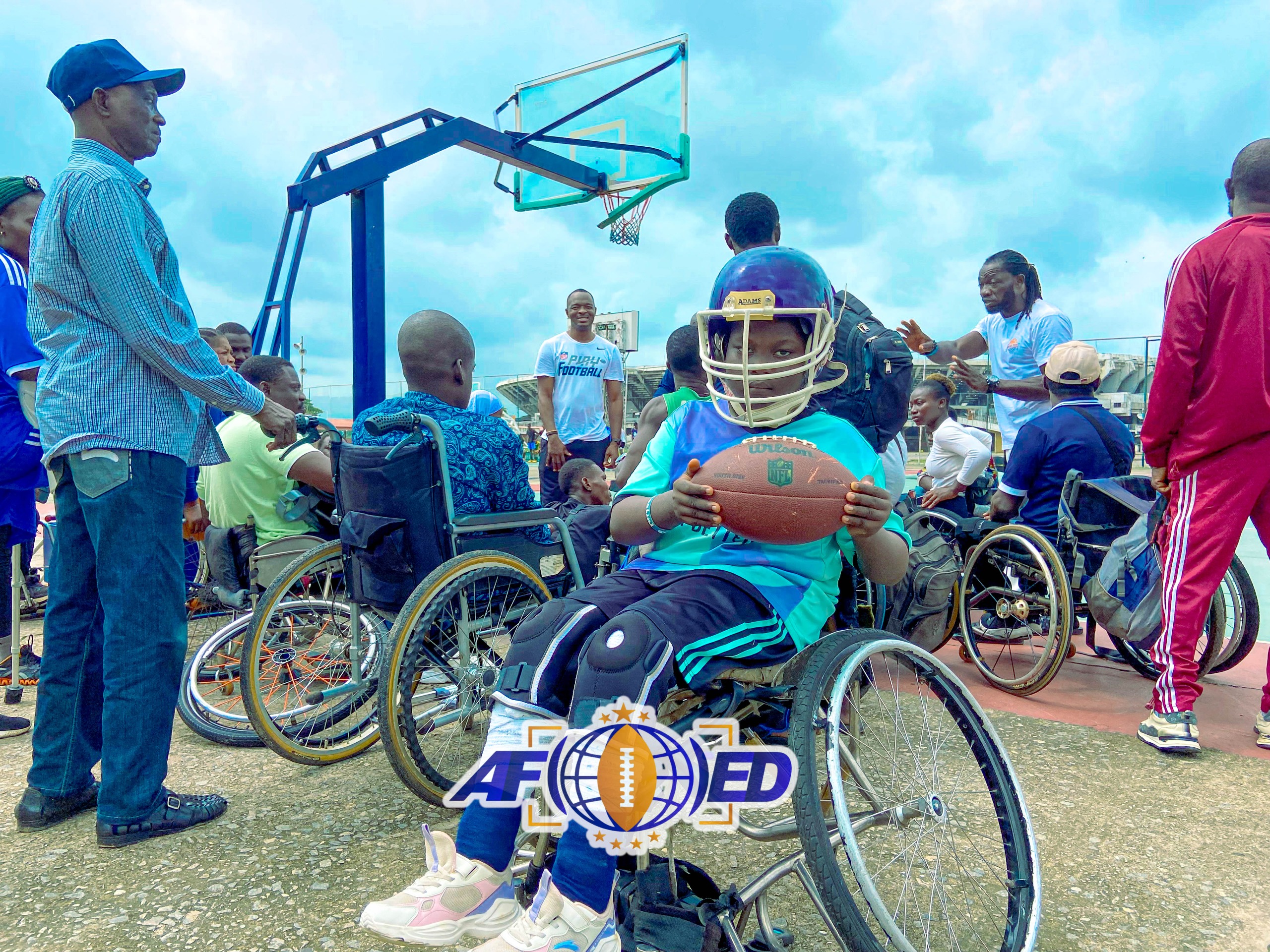
One by one. In wheelchairs, on crutches, with helpers, with families. Athletes who had never touched an American football. People who had never been invited to participate in any organised sport. Young men and women who had been told — by society, by circumstance, sometimes by their own communities — that sport was not for them.
They came anyway.

The First Snap
When the ball was snapped for the first time — when a wheelchair athlete received that ball, turned, and made a play — something shifted in the air. It was not dramatic. There were no fireworks. No cameras flashing for the front page. But everyone who was there felt it.
It was the sound of a barrier breaking.
In that single action — a ball snapped, caught, and moved — years of planning crystallised into reality. This was no longer an idea. No longer a concept on paper. No longer a conversation in boardrooms. It was real. It was happening. And the athletes — these extraordinary, resilient, courageous athletes — were making it happen.
"That first snap wasn't just football. It was a declaration — that disability does not disqualify, that inclusion is not charity, and that Nigeria's sporting future belongs to everyone."

What I Saw That Day
Beyond the logistics and the drills, what I saw that day was transformation in real time.
I saw athletes who arrived uncertain leave with fire in their eyes. I saw volunteers — many of whom had no prior connection to disability sport — find purpose and meaning in their work. I saw coaches adapt, improvise, and lead with empathy and expertise in equal measure.
I saw something else too: community. People stayed long after the session ended. They talked. They laughed. They exchanged numbers. They made plans. For many of these athletes, this was the first time they had been part of something — genuinely part of something — that saw them as capable, competitive, and worthy of investment.
That is what sport does when it is done right. It does not merely entertain or exercise. It connects. It dignifies. It creates belonging.
The Road Ahead
One session does not make a movement. I am under no illusions about the scale of work still ahead. We need more athletes. More coaches. More equipment. More venues. More funding. More partners. More visibility. The list is long, and the resources are finite.
But the foundation has been laid. The first snap has been taken. And from this point, we build — session by session, athlete by athlete, partnership by partnership.
Over the coming months, AFEDEV plans to expand athlete recruitment across multiple regions, develop specialized coaching certifications, organize exhibition matches, pursue international partnerships, and begin laying the groundwork for structured adaptive football competitions.
We will face challenges. There will be setbacks. Some doors will close. But we have learned something essential in this journey: when you create genuine opportunity, people respond. When you build with integrity, others want to build with you.

A Personal Reflection
I have been asked why this matters so much to me personally. Why adaptive sport? Why now? Why take on something so complex when there is already so much to do?
The answer is simple: because it is right. Because I have seen what happens when people are excluded — not through malice, but through indifference. Because I know what sport gave me and what it can give others. And because I refuse to lead an organization that talks about inclusion without doing the difficult, unglamorous, resource-intensive work of actually being inclusive.
This is not a side project. This is not a footnote. Wheelchair American Football is central to what AFEDEV stands for — and it will be treated with the same seriousness, investment, and ambition as everything else we do.

To the Athletes
To every athlete who showed up that day — and to those who will come after — I want you to know something: you are not participants in someone else's story. You are the authors of your own. What we are building, we are building together. Your voices, your experiences, your ambitions — they are at the centre of this.
This is your sport. Your platform. Your future. We are here to create the conditions, to open the doors, to remove the barriers — but the journey is yours.
And it starts with a snap.
"The first snap was not an ending. It was a beginning — a declaration that from this day forward, Nigerian sport belongs to everyone willing to compete, to grow, and to lead."


